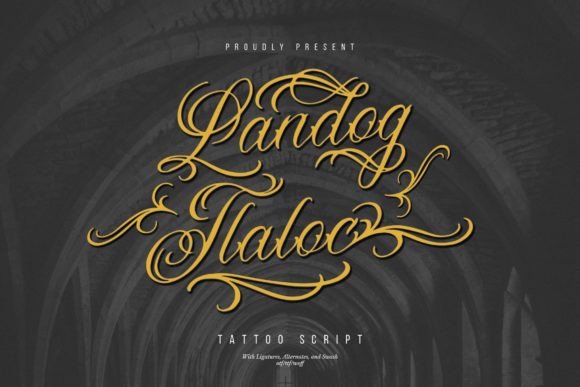
Landog Tlaloc: A Refined Script Font for Editorial and Branding Projects
Choosing a Font for a Lifestyle Blog Redesign
I recently sat down to refresh the header and featured quote graphics for a small lifestyle blog focused on slow living and mindful design. The goal was to introduce a font that felt personal, yet polished—something with warmth and rhythm that could anchor the editorial tone without overpowering the content. That’s when I found Landog Tlaloc, a script font from the Script Amp category, and began testing it in real layout scenarios.
Visual Character and Editorial Mood
Landog Tlaloc has a soft, flowing structure that mimics natural handwriting but with a refined, intentional rhythm. It doesn’t feel rushed or overly decorative, which is a common pitfall with many script fonts. Instead, it carries a quiet confidence—ideal for editorial projects that aim to feel personal without veering into informality. Its strokes are balanced, with gentle curves and subtle variations in weight that enhance its legibility, especially at larger sizes.
In the blog header, it brought a sense of warmth and approachability. When used for pull quotes in a feature article about minimalist home design, it added a visual pause that guided the reader’s eye without disrupting the reading flow. It’s a font that supports editorial mood without shouting for attention.
Practical Uses in Publishing and Design
This font shines in short-form, high-impact applications. I tested it in several contexts:
- As a blog header font—worked well with a clean sans serif subheader
- In pull quotes to break up long-form articles—added a decorative but readable accent
- For ebook title pages—gave a soft, elegant touch to a digital recipe collection
- On printable planners—its organic flow complemented the hand-drawn aesthetic
- In newsletter graphics—added a human feel to a weekly curation of design links
It’s particularly effective in projects where the font is used as a design element rather than a vehicle for dense body text. Its personality is expressive, so it works best when given visual space to breathe.
Readability Across Formats
One of the first things I checked was how Landog Tlaloc performed across different formats. In a digital magazine layout, it worked well as a cover title font. On mobile, it remained legible as long as the size was kept above 20px. For PDF exports like coaching workbooks or printable guides, the font rendered cleanly and preserved its character without jagged edges or inconsistent spacing.
However, I wouldn’t recommend it for long paragraphs or body copy—its expressive nature makes it less ideal for extended reading. It also doesn’t suit formal reports or academic-style layouts where neutrality and structure are key. In those cases, pairing it with a more restrained font is essential.
Font Pairing and Editorial Consistency
Like most script fonts, Landog Tlaloc needs a strong supporting cast. I paired it with a classic serif font like Georgia for article body text, which created a nice contrast and maintained a sophisticated editorial tone. For captions and navigation menus, a clean sans serif like Helvetica Neue grounded the design and improved usability.
This kind of pairing is crucial for maintaining visual hierarchy and ensuring that the font supports the content rather than distracts from it. The goal is to use Landog Tlaloc where it excels—headers, quotes, and decorative accents—while relying on more neutral fonts for readability.
Technical and Licensing Considerations
Before embedding the font into client deliverables like a digital course PDF or a branded printable planner, I made sure to review the licensing terms. The font includes standard commercial use permissions, which is essential for content creators who sell digital products or offer branded templates.
It also comes with multiple styles, ligatures, and alternates, which added flexibility in layout design. Multilingual support was sufficient for the blog’s international audience, and the included file formats (OTF, TTF) made it easy to integrate into both design tools and web platforms.